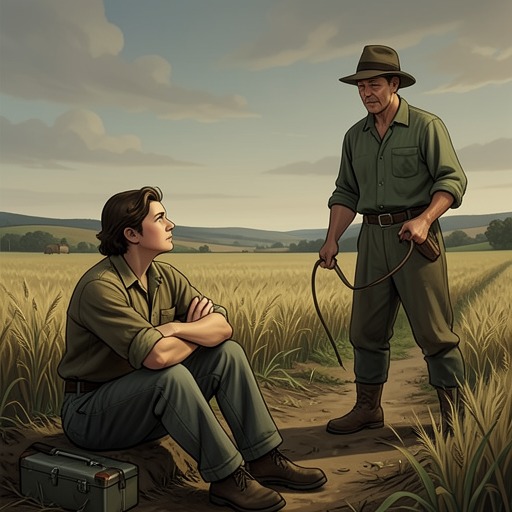
Emigration as escape from poverty and oppression
The EmigrantsEmigration as escape from poverty and oppression is a central organizing idea in The Emigrants: people leave not for one reason but because the hardships of life in Sweden make staying increasingly untenable. The journey gathers together debt-burdened farmers, dissatisfied servants, religious dissenters, and people fleeing personal or social difficulties. Their varied motives become a collective movement toward America, where the promise of land and independence is powerful but still uncertain, and where passage itself exacts a substantial price.
Pressures to Leave
The emigrants from Ljuder Parish form a cross-section of the forces that could drive people out of Sweden. Their reasons include crop failure, persecution by civil authorities, religious dissent, personal problems, social ostracism, and unfair employment practices. The group is united less by a common identity than by dissatisfaction with the circumstances each person faces. The novel makes migration a gathering point for distinct grievances rather than a single, uniform response to poverty.
For Karl Oskar Nilsson, the pressure is economic and tied to the limits of his farm. After years of work at Korpamoen, he and Kristina have become several hundred riksdaler poorer, despite laboring to their utmost. He sees no prospect of improving their position by continuing to work the land: the farm’s obligations and their accumulated difficulties threaten to consume their strength without securing a better future. His application for emigration papers gives that hardship a plain formulation: he has debts, faces hardship, and cannot improve his situation at home.
The costs of taking over Korpamoen help explain why effort alone has not brought security. Karl Oskar bought the farm, cattle, and equipment for 1,700 riksdaler, with an 800-riksdaler mortgage. His parents, Nils and Märta, retained rights to a room, provisions for a cow and sheep, land for sowing, use of the farm team, and twelve bushels of grain each year. These obligations provided for his parents but also weighed heavily on the small holding. After three years, the family had one fewer cow and seventy riksdaler more debt than when Karl Oskar took possession. Emigration thus answers not simply a bad harvest but a deeper failure of their household economy to turn hard work into security.
Other departures give the idea of escape a more openly social or personal edge. Robert Nilsson says he dislikes masters; Arvid wants to get away from the Bull of Nybacken; Ulrika of Västergöhl condemns Sweden as a place she wants to leave; and Jonas Petter of Hästebäck says he can no longer endure living with his wife. These motives are not interchangeable. Together, however, they show how emigration offers a way out of several kinds of constraint, from employment relations and social exclusion to conflicts within a household.
A Promise Set Against Uncertainty
America attracts Karl Oskar as a place where work might finally benefit his family. He seeks a land where he can help himself and his own through his labor. That aspiration turns migration into more than flight from hardship: it is also a wager that work will have a fairer return elsewhere. The contrast is especially pointed because Karl Oskar is hardworking and knowledgeable about farming, yet his efforts at home have not overcome debt and the farm’s obligations.
Kristina Johansdotter does not share her husband’s confidence. She agrees to accompany him, but with hesitation and regret. She doubts the reports on which his hopes depend: no one has promised them land, they have no deed to a holding awaiting them, and they know no one who has seen North America and can reliably describe it. To her, the decision rests on rumor, printed accounts, and her husband’s belief, not on a guarantee. Her misgivings expose the gap between America as an imagined opportunity and the information actually available to those preparing to go.
The group’s routes out of Sweden are also shaped by a wider current of rumor and example. News of fertile land travels from neighbor to neighbor through hamlets and parishes, stirring communities where land is scarce and customary life offers little room for change. At first the movement is tentative: some people are drawn by the possibility of land, while others distrust what they cannot know. The ocean and the destination are both unfamiliar. Emigration grows from that tension between an established, constrained home and an alluring but unverified alternative.
From Private Decisions to Group Migration
The choice to leave becomes actionable through a chain of arrangements. Karl Oskar and Robert have written to a firm in Karlshamn and secured passage on the Charlotta, a merchant ship carrying cargo and emigrants to New York. They plan to sail in early April, when the winter storms have passed and there will still be time to plant after arrival. A down payment of one hundred daler covers transportation for six people. Karl Oskar then offers to help Danjel Andreasson arrange passage, repaying, in practical terms, the earlier help Danjel gave him with mortgage interest. Danjel’s household joins the undertaking, with nine people in all, including children and household members.
These connections transform separate intentions into a group journey. At Åkerby Junction, the emigrants meet with their wagons and organize the onward travel to Karlshamn. Sixteen people are leaving: nine adults and seven children. Danjel’s party includes his wife, four children, and Ulrika; two people unable to fit on his wagon ride with Jonas Petter, including Arvid and Ulrika’s daughter Elin. Robert, who once expected to escape secretly and travel alone with Arvid, now travels openly alongside his fellow farmhand. The shared route does not erase the very different reasons that brought them there; it makes those reasons part of one practical undertaking.
Preparation also reveals the cost and limits of the escape. After selling Korpamoen and its belongings, Karl Oskar has 1,200 daler left after debts are deducted. Passage for his family—three adults and three children—costs 675 daler, nearly half the remaining sum. He expects to arrive with about 500 daler, still needing to pay an entrance fee and onward transportation to an unknown settlement. Land may be available at little cost, but the family will have limited money for livestock and tools. Kristina sews their remaining funds into a sheepskin bag that Karl Oskar can wear against his body. The plan depends on hope, but also on protecting a small reserve through a long and costly journey.
Leaving openly matters to Karl Oskar. Although a person of good character could depart without petitioning the King, he asks the dean for his papers rather than leaving as though he had done wrong. Asked why he wants to emigrate, he answers that debts and hardship have made it impossible to improve his situation at home. The exchange places economic necessity in conflict with a religious explanation of suffering: the dean argues that trials are sent for the soul’s betterment, while Karl Oskar’s decision treats departure as a response to material conditions that faith alone will not alter.
The Meaning and Cost of Escape
The emigrants’ farewell to Sweden gives the idea of escape a divided emotional character. From the departing ship, one account recalls a farm lost to foreclosure and debts that could never be repaid; another condemns exhausting labor and the contempt shown to poor workers. A further voice resents the minister and the many people empowered to give orders. Yet even those who insist that they will not regret leaving remember parents, relatives, friends, and the happiness of youth at home. Emigration can mean release from poverty or authority without making attachment to the old country disappear.
The crossing tests the promise on which departure rests. The voyage brings storms, illness, confinement, and suffering; scurvy and ship fever weaken the emigrants, while the monotonous life aboard depresses them. Their movement away from oppressive conditions at home is not yet arrival at freedom: for the duration of the passage, they are confined to the ship and dependent on the hazards of the crossing. The physical demands of migration expose a cost that the hopeful picture of fertile land cannot contain.
When green land finally appears, the sight reverses the passengers’ loss of spirit. They recognize that they have crossed the sea and see living ground again; renewed energy and ambition spread among them, including among some weakened by illness. The moment confirms that escape has carried them to another shore, but it does not settle the question Kristina raised: what the land will offer, or whether work there will deliver the security sought. In the novel, emigration is both a practical response to poverty and oppression and a passage from known hardship into an uncertain future.